
Eccleston Mere
I had a quick look around this morning...
Mute Swan 7 (2 adult, 5 juv)
Chiffchaff 1
Several more juvenile chiffchaff/willow warbler - too fast for me to id.
Goldcrest 1
Lots of coot and tufted duck on the water and one male mallard with a very pale supercillium that made me walk around to the other side just to make sure!
Damian P
Mute Swan 7 (2 adult, 5 juv)
Chiffchaff 1
Several more juvenile chiffchaff/willow warbler - too fast for me to id.
Goldcrest 1
Lots of coot and tufted duck on the water and one male mallard with a very pale supercillium that made me walk around to the other side just to make sure!
Damian P
Corncrake at Fir Tree farm, Kings Moss 1/9/14
On 1st September 2014 I was due to go to Warrington to harvest Lesser Knapweed seed. At 9am I received a call telling me that my expected lift would not be arriving til 11am. I had a quick look round Inglenook farm in Rainford, where we are based. There was little around apart from my first returning Wheatear of the autumn. As I had time to kill I thought I'd go and have a look in the sheep fields at Windle Moss farm as I have had Common Redsarts there in the past as well as regular Tree Sparrows and Corn Buntings. On arrival the first bird I put my bins on was a Spotted Flycatcher flycatching from a Hawtorn bush. I watched it for while as it was constantly harassed by a Reed Bunting. Pleased with this sighting I headed back to Inglenook only to find that we had been let down with our lift. As well as our wildflower production fields at Inglenook we also have some considerable land at Fir Tree farm in Kings Moss so I decided to take my tractor up there and mow some weedy areas ready for re-sowing in the autumn. The area I was concentrating on was around 2 hectares sown in the spring with Cornflower and Corn Poppy but due to the heavy infestation with arable weeds it was not worth us harvesting it and a very thick sward had grown up. At around 14:00 I saw a small bird just behind the front left hand wheel of the tractor. My tractor is an old 1980s Ford (6410 if anyones interested) and this bird was therefore less than 6 feet away from where I sat. I watched it as it crept out into the newly mown stubble keeping on a low profile with its neck stretched out in front of it and its long strong looking legs behind. I was initially at a total loss as to what it was. I am very familiar with Pheasants and both Partridges of all ages and for some reason my initial thought was it was a Quail (a bird I have also flushed with our combine in the past). Then it dawned on me exactly what it was. By this time it had crept about 2m from the tractor and I was able to watch it closely though my bins which are always round my neck when I'm mowing (this habit has lead to stunning views of birds like Jack Snipe and Hen Harrier in the past). The bird appeared to be largely orangey brown with black spots along its back. The head appeared to be a similar colour with no obvious grey which leads me to think it was either a female or an immature bird and it had a pale strong looking billl. It was obviously smaller than a Partridge but larger and longer than a Qail. I watched until it reached the edge of the field a disappeared into heavy cover in the adjacent cow field. I sat and watched for about 30 minutes but there was no further sign. I put the news out on Twitter and Birdguides (who put it down as being in Manchester!). I stayed for another 45 minutes before leaving the site. I returned later where I told the farmer who owns the land. He was made up and said he remembers them being on the farm in the 1950's when the area was largely hay meadow. Following a tweet, Paul Brady turned up at about 17:00 and we searched for a further hour without success. Alan Abbot who owns the land did report seeing a small bird cross a tractor track and possibly hearing a Corncrake type call. I have been back up there today (3rd) and mown the rest of the field but sadly there was no sign. I am of the opinion that it is possible that birds like this and others like Jack Snipe and Quail are far more regular, on passage, in our area than we think. If I had not disturbed this bird it would have slipped under the radar as apparently they rarely call away from breeding sites. I've seen some amazing birds this year but this has to be up there with them all.
Kind regards
Damian Young
Kind regards
Damian Young
Eccleston Mere
Spotted flycatcher on the edge of the woodland by the stream this morning, also 4 teal, but no sign of yesterdays black tern.


Eccleston Mere
While the sun was shining this morning I went down to Eccleston Mere to see if there was any sign of the recently sighted Spotted Flycatchers. I waited by the dead wood for about 20 minutes, looking at every small bird. A single Spotted Flycatcher eventually appeared but while waiting I managed to see:

Willow Warbler, Chiffchaff, Blackcap, Whitethroat, Great Spotted Woodpecker (juv.), Nuthatch, Goldfinch, Greenfinch, Chaffinch, Blue Tit, Great Tit, Long-Tailed Tit
Also 2 Kingfisher plus the usual suspects on the mere .
Spotted Flycatcher
Billinge Hill - Migration Hat-trick!
I struck it lucky today as Billinge Hill delivered 3 good quality scarce migrants.
It was quite windy but with a couple of days of easterly winds and the east coast having already had many, many migrants I was rather hopeful.
On the way up not long after I spotted a family of grey partidge I heard a shrill, slightly drawn-out pipitty call from overhead, to me it recalled a quieter less harsh Richard's pipit, I thought the most likely candidate was a tree pipit given the location and time of year. Upon a frantic search of xeno-canta I confirmed that to my ears it was indeed a tree pipit.
As mentioned it was quite windy so I decided to stick to the westerly side of the hill and look for sheltered spots. The "raspberry" patch near to the bench and tarmacked road produced a tit flock containing blue, great, long-tailed and willow tit. It also carried a chiffchaff .... though was I too optimistic in hoping for a yellow-browed warbler? Keeping me entertained a blackcap tacked away whilst a whitethroat scolded me but no rare warbler.
I skirted the edge of the beacon and headed for the far side of the hill past the pine copse where the sun came out and I was out of the wind, this looked like a likely spot .... then a goldcrest called or was it? then I heard a willow warbler or was it? i found neither bird but locked onto a grey-brown, friendly faced, beady-eyed, tail-flicking bird and it was making the willow warbler noise! I was confident I knew what it was and then a flash of orange-red from the rear confirmed a female redstart. This was my 2nd for the hill in two years though the other was a spring bird.
A good find and I nice little icing on the cake would be that goldcrest (one of my faves) that was calling but then a familiar in-and-out flight caught my eye, sitting where the redstart had just been was a spotted flycatcher! I watched both birds occupy this little sheltered spot for a while with the redstart favouring the fence and feeding on the floor whilst the flycatcher caught insects in the air from its favoured branch.
A robin flitted about too but then another suspiciously redstart/flycatcher bird was tantalisingly out of sight and seen only briefly ... it was like being on the east coast!
Running out of time I headed down the hill but not before checking out one of the local little owls, where I also saw and heard a bright, super-fresh willow warbler as yellow as a canary!
The winds are still easterly so tomorrow could hold one or two more, maybe even one of the much more vaunted east coast regular easterly migrants could be found on our patch? Wryneck, red-backed shrike or barred warbler anyone?
Paul B
Eccleston Mere
Spotted flycatcher 2 in dead wood at southern end
Goosander 1 imm (male?)
Willow tit 1
Kingfisher 1
Buzzard 2
Chiffchaff 1 singing
Coot 130
Mute swan 6 (adult & 5 cygnets)

Goosander 1 imm (male?)
Willow tit 1
Kingfisher 1
Buzzard 2
Chiffchaff 1 singing
Coot 130
Mute swan 6 (adult & 5 cygnets)
Eccleston Mere
Common tern 1
Coot 121 (a new record)
Kingfisher 1
Mute swan 4 (ad & 3 cygnets)
Swallow 50
House martin 20
Nuthatch 1 calling
Coot 121 (a new record)
Kingfisher 1
Mute swan 4 (ad & 3 cygnets)
Swallow 50
House martin 20
Nuthatch 1 calling
Overheard and Overhead
Birdwatching never stops as I found out on Wednesday night as I sat outside the Mason's in Billinge, the local tawny's were putting on a aural show whilst the meteor shower provided a visual display. I also heard what sounded like a very quiet (or very high up) oystercatcher - does anyone know if any other wader makes a similar night time migration call to an oyc but quieter?
In addition, I've just had two very high Raven over my house in Billinge a definite reason for keeping the windows open when you're inside - KRONK-KRONK!
Paul B
Newton Lake
Two visits in two days hoping that Bertha blew in a seabird or even (dare I dream?) a scarce wader ... unfortunately not!
The water level was very high on Sunday and hence no waders but then today even withdropping water level and the return of the mud there was still no waders!
However the usual suspects were present:
Kingfisher
Grey Wagtail
Little grebe x3
Gadwall x2
And the bonus for me were the presence of at least 5 teal ... is it autumn already?
Good Luck in your quest for the beginnings of autumn!
Paul B
Eccleston Mere
Common tern 1 adult
Coot 119 (a new record)
Kingfisher 1
Mute swan 7 (adult + 6 cygnets)
Great crested grebe families with 5 and 2 chicks.
Swallow 50
Coot 119 (a new record)
Kingfisher 1
Mute swan 7 (adult + 6 cygnets)
Great crested grebe families with 5 and 2 chicks.
Swallow 50
Billinge Area
There were very few birds around this afternoon probably due to the wind, but I was pleased to see little owls at both of the known sites in Billinge. The flock of mistle thrush was the biggest I've ever seen. They were in the field west of Red Barn Farm.
Little Owl 2 (One at Red Barn Road, and one near Promised Land Farm)
Mistle thrush 35 in a single flock
Kestrel 2
Yellowhammer 8


Little Owl 2 (One at Red Barn Road, and one near Promised Land Farm)
Mistle thrush 35 in a single flock
Kestrel 2
Yellowhammer 8
Damian P
Red Barn Road
We all went out to look for owls this evening. We couldn't see or hear the little owls, but saw a barn owl flying over the fields and heard a tawny owl and a grey partridge calling.
Damian P
Red Underwing Moth, My Garden Eccleston
I found this Red Underwing moth in my garden this evening. I saw it in flight at first and thought it was a butterfly, luckily it landed on my shed...

Damian P
Damian P
Rainford Mosslands
There are still plenty of yellow wagtail in the potato field along the Old Coach Road. It's quite difficult to count them as they keep flying around disappearing from view. There were at least four today and of those that I could see well enough, there were two females and one juvenile.
The stoat was in front of me on the path between Moor Game Farm and Mossnook Farm. It kept popping (or is that a weasel!?) in and out of the undergrowth. It was by far the best views I've ever had of one, and the first time I've managed to get a photo.
Yellow wagtail 4+ (2f, 1 juv)
Corn Bunting 1 (just North of Inglenook Farm)
Meadow Pipit 1
Yellowhammer 1
Kestrel 1
Buzzard 2
Brown Hare 2
Stoat 1


Damian P
The stoat was in front of me on the path between Moor Game Farm and Mossnook Farm. It kept popping (or is that a weasel!?) in and out of the undergrowth. It was by far the best views I've ever had of one, and the first time I've managed to get a photo.
Yellow wagtail 4+ (2f, 1 juv)
Corn Bunting 1 (just North of Inglenook Farm)
Meadow Pipit 1
Yellowhammer 1
Kestrel 1
Buzzard 2
Brown Hare 2
Stoat 1
Damian P
Eccleston Mere
GS Woodpecker 3 (1m, 1 juv, 1?)
Blackcap 3 (1f, 2 juv)
Willow warbler 5 one still singing
Nuthatch 1
Treecreeper 1
GC grebe 2 family groups with 6 chicks
Damian P
A couple of surprises at Eccleston Mere
I arrived at the mere just as Damian was leaving and didn't see half of the birds he did. I did manage a couple of surprises though........
A female banded demoiselle in the hedge on the western shore of the mere was a very unexpected sight, and was unsurprisingly a new species of damselfly for the mere (as far as I know). They have become established in St Helens in recent years, but are still almost wholly confined to the Sankey brook, and any record away from there is a good one. They usually prefer slow moving, well vegetated, clear rivers, but it's not unprecedented for them to me found around lakes, and there have been a small number of records from Bold Moss in recent years. I can't imagine them breeding at the mere, there's just not the habitat, the stream is too small, so these extralimital records are probably individuals dispersing and looking for new sites.
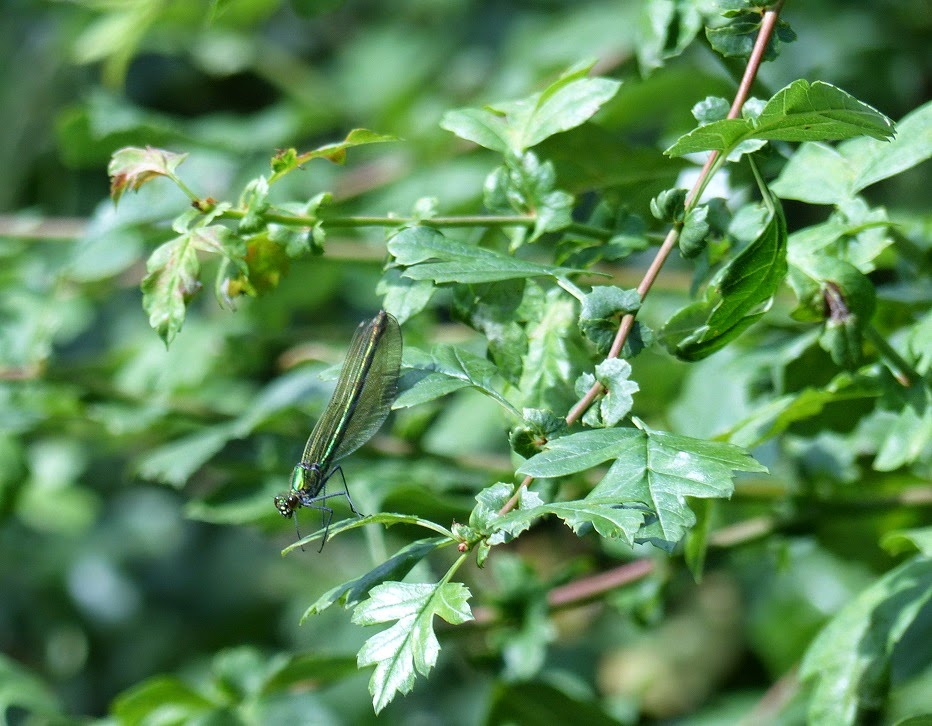
Female banded demoiselle.

On the water I was surprised to see a great crested grebe family with 5 chicks. I usually expect to see two or three. I don't think I've ever seen 5 before. There were at least 4 other chicks on the mere today, so if they can all fledge it looks like they will have had a good year this year.

Great crested grebe family.
Other birds at the mere today: Kingfisher, 2 mute swans with 6 cygnets, 100 coot, 12 tufted ducks.
I've put a piece about grasses at Eccleston Mere today on my blog.
A female banded demoiselle in the hedge on the western shore of the mere was a very unexpected sight, and was unsurprisingly a new species of damselfly for the mere (as far as I know). They have become established in St Helens in recent years, but are still almost wholly confined to the Sankey brook, and any record away from there is a good one. They usually prefer slow moving, well vegetated, clear rivers, but it's not unprecedented for them to me found around lakes, and there have been a small number of records from Bold Moss in recent years. I can't imagine them breeding at the mere, there's just not the habitat, the stream is too small, so these extralimital records are probably individuals dispersing and looking for new sites.
Female banded demoiselle.
On the water I was surprised to see a great crested grebe family with 5 chicks. I usually expect to see two or three. I don't think I've ever seen 5 before. There were at least 4 other chicks on the mere today, so if they can all fledge it looks like they will have had a good year this year.
Great crested grebe family.
Other birds at the mere today: Kingfisher, 2 mute swans with 6 cygnets, 100 coot, 12 tufted ducks.
I've put a piece about grasses at Eccleston Mere today on my blog.
Red Barn Road Billinge Sunday 20th July 9pm-10pm
Yellowhammers (Several calling from different locations along the road and footpath)
Corn Bunting
Little Owl (2) One sat on a telegraph pole while a second one one on the roof of the old sheds near the sheep field)
Barn Owl (1) Sat on a fence post on the eastern end of the road towards Billinge.
Tawny Owl Not seen but heard calling.
Corn Bunting
Little Owl (2) One sat on a telegraph pole while a second one one on the roof of the old sheds near the sheep field)
Barn Owl (1) Sat on a fence post on the eastern end of the road towards Billinge.
Tawny Owl Not seen but heard calling.
My Garden, Eccleston
Three ravens flew over my garden this afternoon heading South East.
Cheers, Damian
Cheers, Damian
Subscribe to:
Posts
(
Atom
)